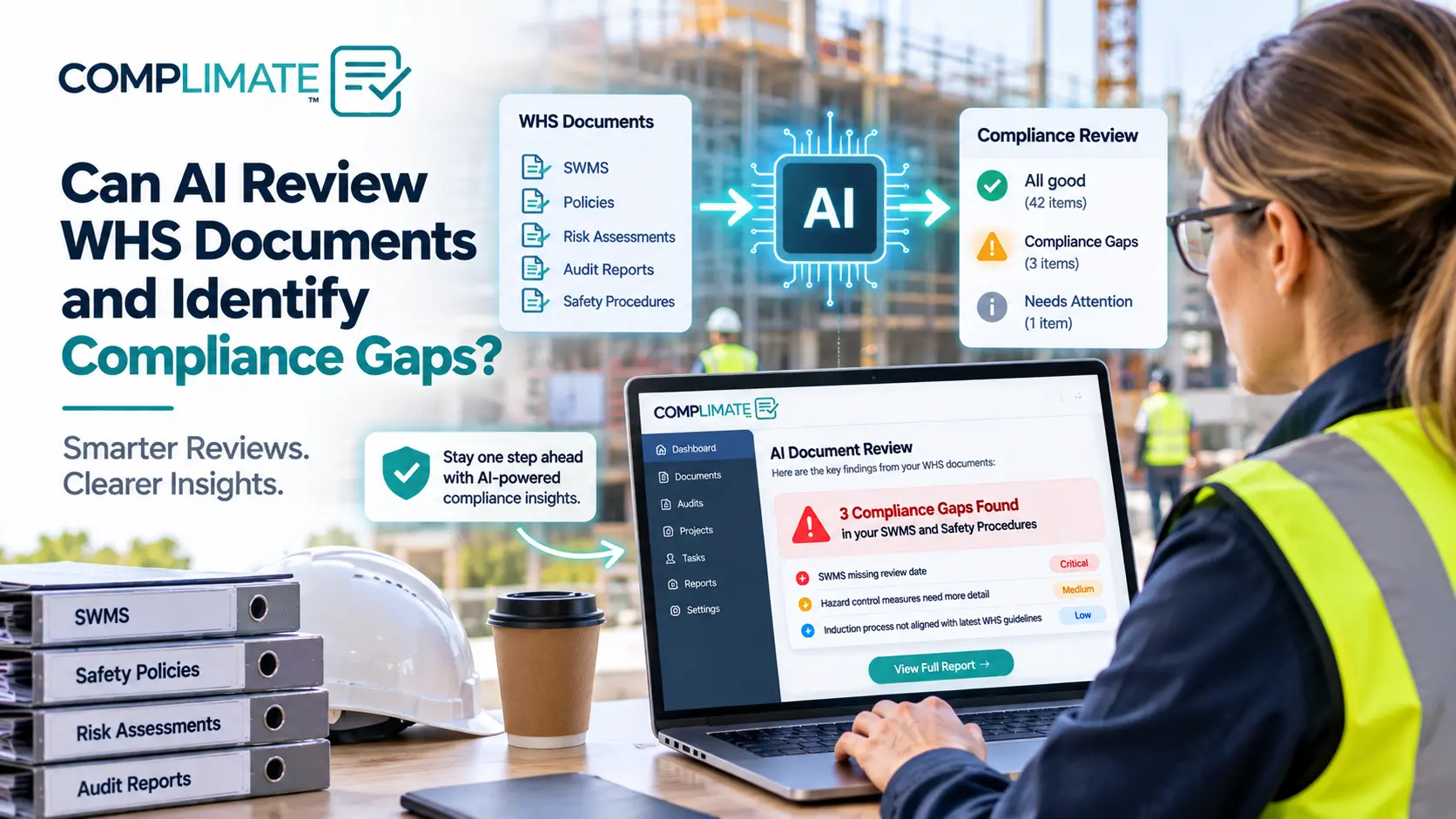
Work Health and Safety (WHS) documents help Australian businesses communicate safety responsibilities, manage workplace risks and maintain compliance records. But reviewing these documents can take time, especially when policies, procedures, Safe Work Method Statements (SWMS), risk assessments and registers are stored in different places.
Can artificial intelligence (AI) make this process easier?
Yes. AI can help review WHS documents, identify missing information, highlight inconsistencies and flag potential compliance gaps. It can also help teams compare their documentation with relevant WHS requirements and organise follow-up actions.
However, AI should support—not replace—qualified WHS professionals. Its findings need to be checked against current legislation, workplace conditions and the organisation's actual responsibilities.
What Does AI WHS Document Review Mean?
AI WHS document review uses artificial intelligence to analyse workplace safety documents and provide insights about their content.
Depending on the system and the information provided, AI may help identify:
Missing sections or incomplete information.
Outdated policies and procedures.
Inconsistent safety instructions across documents.
Unclear responsibilities and approval processes.
Potential gaps in risk assessments and SWMS.
Missing references to relevant safety requirements.
For example, a business might upload its emergency response procedure and ask an AI assistant to identify missing information or compare the document against relevant WHS requirements.
The AI can highlight areas that may need attention, helping the WHS manager decide what to investigate further.
How Can AI Identify WHS Compliance Gaps?
AI can support document reviews in several practical ways.
1. Identify missing information
AI can examine a document's structure and content to identify sections that appear incomplete.
For example, a risk assessment may describe workplace hazards but provide limited information about control measures or who is responsible for implementing them.
AI can flag these areas for further review.
2. Compare documents with WHS requirements
AI can help compare company documentation with relevant WHS legislation, regulations, standards and guidance.
For example, a WHS manager could ask whether an existing procedure addresses a particular workplace responsibility.
The AI may highlight relevant requirements and identify where the document appears to provide limited information.
The result should be treated as a review finding, not a legal determination.
3. Review SWMS and risk assessments
Safe Work Method Statements and risk assessments need to reflect the work being performed and the risks involved.
AI can assist by checking whether a document clearly describes:
The work activities being performed.
Potential hazards and associated risks.
Control measures.
Responsibilities for implementing controls.
Review and approval information.
It may also identify inconsistencies or missing details that require attention.
A competent person must still confirm that the document reflects actual site conditions and the work being undertaken.
4. Find inconsistencies across documents
Businesses often maintain multiple policies, procedures and registers.
Over time, these documents can become inconsistent. For example, an induction procedure may refer to an approval process that differs from the process described in a separate company policy.
AI can help compare document information and highlight possible inconsistencies.
This can be particularly useful for businesses managing multiple sites, teams or contractors.
5. Help prepare for WHS audits
Before an internal or external audit, AI can help review available documentation and identify areas that may need attention.
It can highlight missing evidence, incomplete records and documents that may require updating.
This gives the compliance team a starting point for further investigation and helps prioritise review activities.
What Types of WHS Documents Can AI Review?
The documents an AI system can review depend on its supported file formats, features and reference information.
Common examples include:
AI findings should always be checked against the latest applicable requirements and the organisation's actual workplace activities.
AI Document Review vs Manual WHS Review
AI and manual reviews serve different purposes. Combining them can make document management more effective.
The best approach is to use AI for faster analysis and qualified people for verification, decisions and approval.
How Complimate Helps With AI-Assisted WHS Document Reviews
https://complimate.com.au/ Complimate brings document management, AI-assisted compliance support, audits and corrective actions together in one platform for Australian businesses.
Its AI Compliance Assistant can answer questions using uploaded company documents and cross-reference information with WHS legislation, regulations, ISO standards and government requirements.
Here are some practical ways businesses can use it.
Ask questions about company documents
Teams can ask questions about their uploaded policies, procedures and registers.
For example:
What does our fatigue management procedure say?
Which documents cover emergency planning?
What responsibilities are described in this policy?
This helps employees and managers find relevant information without manually searching through multiple files.
Support document and policy reviews
Complimate provides AI-assisted support for reviewing compliance documents and drafting policies, procedures and other WHS documentation.
Teams can use this assistance to identify areas that may need clarification or further review before approving a document.
Use clause-cited audit insights
Complimate can help map audit findings to relevant WHS Act, WHS Regulation, ISO and government requirements.
This gives compliance teams a structured starting point for investigating findings and understanding which requirements may be relevant.
Turn findings into corrective actions
Identifying a potential gap is only the first step. Businesses also need to decide what action is required.
Complimate's Corrective Action Register helps teams assign responsibilities, set due dates and track actions through to closure.
This connects document reviews and audit findings with practical follow-up work.
You can explore these capabilities on the Complimate WHS and Compliance Management Software page.
What Are the Limitations of AI in WHS Compliance?
AI can make document reviews faster, but businesses should understand its limitations.
AI does not guarantee legal compliance. It can misunderstand information, overlook context or produce incorrect recommendations.
Other limitations include:
Outdated information: AI may not reflect the latest legislative changes unless its reference sources are current.
Missing context: A document may look complete but fail to reflect actual workplace conditions.
Incorrect findings: AI may flag an issue that is not relevant or overlook a genuine risk.
Incomplete documents: Results depend on the quality and completeness of the information supplied.
Human accountability: Businesses remain responsible for their WHS decisions and obligations.
Always verify AI-generated findings, check relevant legal requirements and involve competent WHS personnel before making changes.
How to Introduce AI Into Your WHS Document Review Process
Businesses can start with a simple process:
Collect your documents: Bring together current policies, procedures, SWMS, risk assessments and registers.
Check document versions: Identify outdated, expired or duplicate documents.
Use AI to review selected documents: Ask specific questions about missing information, responsibilities and potential gaps.
Verify the findings: Have a qualified person check the results against workplace conditions and relevant requirements.
Assign corrective actions: Give each approved action an owner and due date.
Review and update: Keep documents current and retain appropriate evidence of changes.
Using this process helps businesses make AI part of a controlled WHS management workflow rather than relying on automated recommendations alone.
Frequently Asked Questions
Can AI check whether a WHS document is compliant?
AI can compare document content with supplied or available compliance references and flag potential gaps. However, it cannot guarantee that a document is legally compliant. A competent person should verify the findings.
Can AI review a Safe Work Method Statement (SWMS)?
Yes. AI can help review SWMS content, identify potentially missing information and highlight unclear hazards, control measures or responsibilities. The final document must reflect the actual high-risk construction work and site conditions.
Can AI compare WHS documents with Australian legislation?
AI tools can help cross-reference documents with relevant Australian WHS legislation and guidance. The accuracy of the result depends on the quality and currency of the reference information, so important findings should be independently verified.
Does AI replace a WHS manager or safety consultant?
No. AI can support document analysis, research and administrative work, but it cannot replace professional judgement, workplace inspections or legal responsibility.
How can businesses track compliance gaps identified by AI?
Businesses can record verified findings in a corrective action register, assign an owner, set a due date and monitor progress until the action is completed. A connected compliance platform can help manage this workflow.
Final Thoughts
AI can make WHS document reviews more efficient by helping businesses identify missing information, compare documents and highlight potential compliance gaps.
But finding a possible gap is not the same as confirming a compliance breach. Every important finding needs human review, workplace context and appropriate follow-up.
For Australian businesses, the most useful approach is to combine AI-assisted document analysis with a structured WHS management process.
Complimate helps bring these activities together through its AI Compliance Assistant, document management, audit insights and corrective action tracking—giving teams a more organised way to manage everyday compliance work.