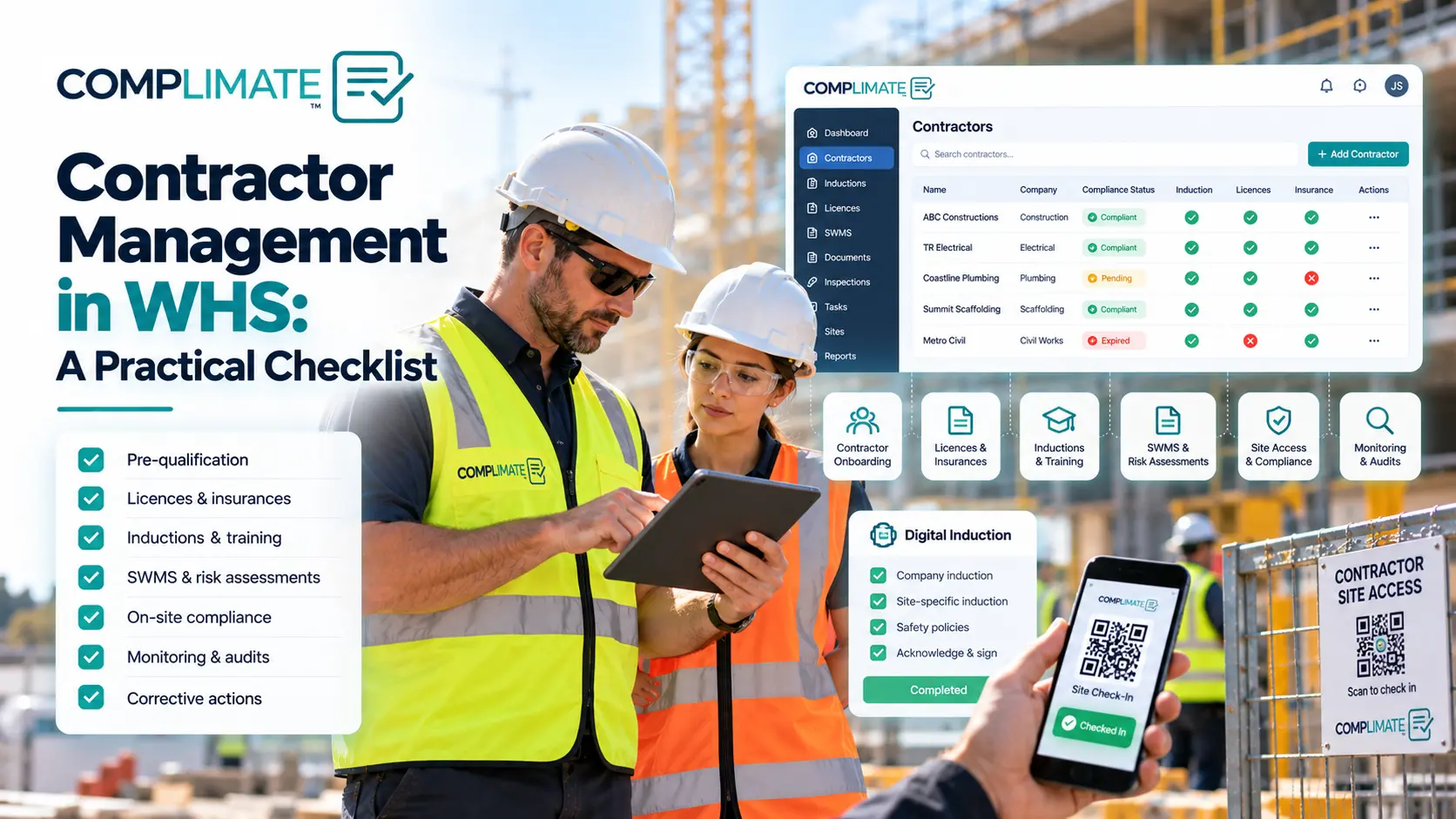
Hiring a contractor doesn't hand your safety duties to them. This guide explains what contractor management means under Australian WHS (work health and safety) laws, and gives you a practical checklist for before, during and after every job.
What is contractor management in WHS?
Contractor management is the process of making sure contractors work safely on your site or for your business. It covers selection, induction, supervision and review.
Under the model WHS laws, contractors and subcontractors count as workers. That means the business engaging them, the PCBU (person conducting a business or undertaking), owes them the same primary duty of care as employees.
At a Glance
What it is: Contractor management is how a business selects, inducts, supervises and reviews contractors safely.
Why it matters: Under WHS laws, you share safety duties with every contractor you engage.
Who should use it: Business owners, site managers and principal contractors.
Biggest benefit: Fewer gaps between who controls a risk and who manages it.
Who is responsible for contractor safety?
Both businesses are responsible. The engaging PCBU and the contractor's own business each hold duties, to the extent each can influence and control the work.
You cannot contract out of these duties. Regulators are clear that the primary duty of care applies regardless of what a contract says. Every PCBU involved must consult, cooperate and coordinate.
In construction, projects worth $250,000 or more need a principal contractor under the model WHS Regulations. The principal contractor must prepare a WHS management plan and obtain SWMS (safe work method statements) for high-risk work.
What should a contractor management checklist include?
Cover three stages of every job.
Before work starts
Check licences, tickets and insurance are current.
Ask for relevant SWMS or risk assessments.
Agree in writing who controls each risk.
Share site hazards, emergency procedures and rules.
During the work
Complete a site induction before anyone starts.
Sign contractors in and out each day.
Check work matches the agreed SWMS.
Report and investigate incidents and near misses.
After the job
Review performance and any incidents.
Close out any open corrective actions.
Update your approved contractor list.
How should you track contractor compliance?
A spreadsheet works for a few contractors. Once you have many contractors or sites, a digital system is easier to keep current.
Software has limits. It only helps if supervisors use it and someone follows up overdue items.
What are common contractor management mistakes?
Relying on the contract. A safety clause doesn't remove your duty.
Checking licences once. Tickets and insurance expire.
Generic inductions. Contractors need site-specific hazards.
Accepting any SWMS. Read it and check it matches the job.
Example: a school engages an electrician to replace lights in a hall. The school checks the electrician's licence and insurance, explains asbestos records and student movement, and books the work for holidays. The electrician supplies a SWMS for working at heights. Both agree who controls access to the hall.
Key Takeaways
Contractors are workers under the model WHS laws.
You cannot contract out of your WHS duties.
Every PCBU involved must consult, cooperate and coordinate.
Check licences, inductions and SWMS before, during and after each job.
Frequently Asked Questions
Are contractors considered workers under WHS law?
Yes. Under the model WHS Act, contractors and subcontractors are workers.
Who is responsible for a contractor's safety?
Both the engaging business and the contractor's business, based on what each controls.
Can I transfer WHS duties to a contractor through a contract?
No. Each PCBU keeps its duties regardless of contract terms.
When is a principal contractor needed?
For construction projects worth $250,000 or more under the model WHS Regulations.
Conclusion
Good contractor management is a routine, not a one-off check. Agree who controls each risk, keep records current, and review every job.
This is general information. Rules vary by state, so check with your regulator.