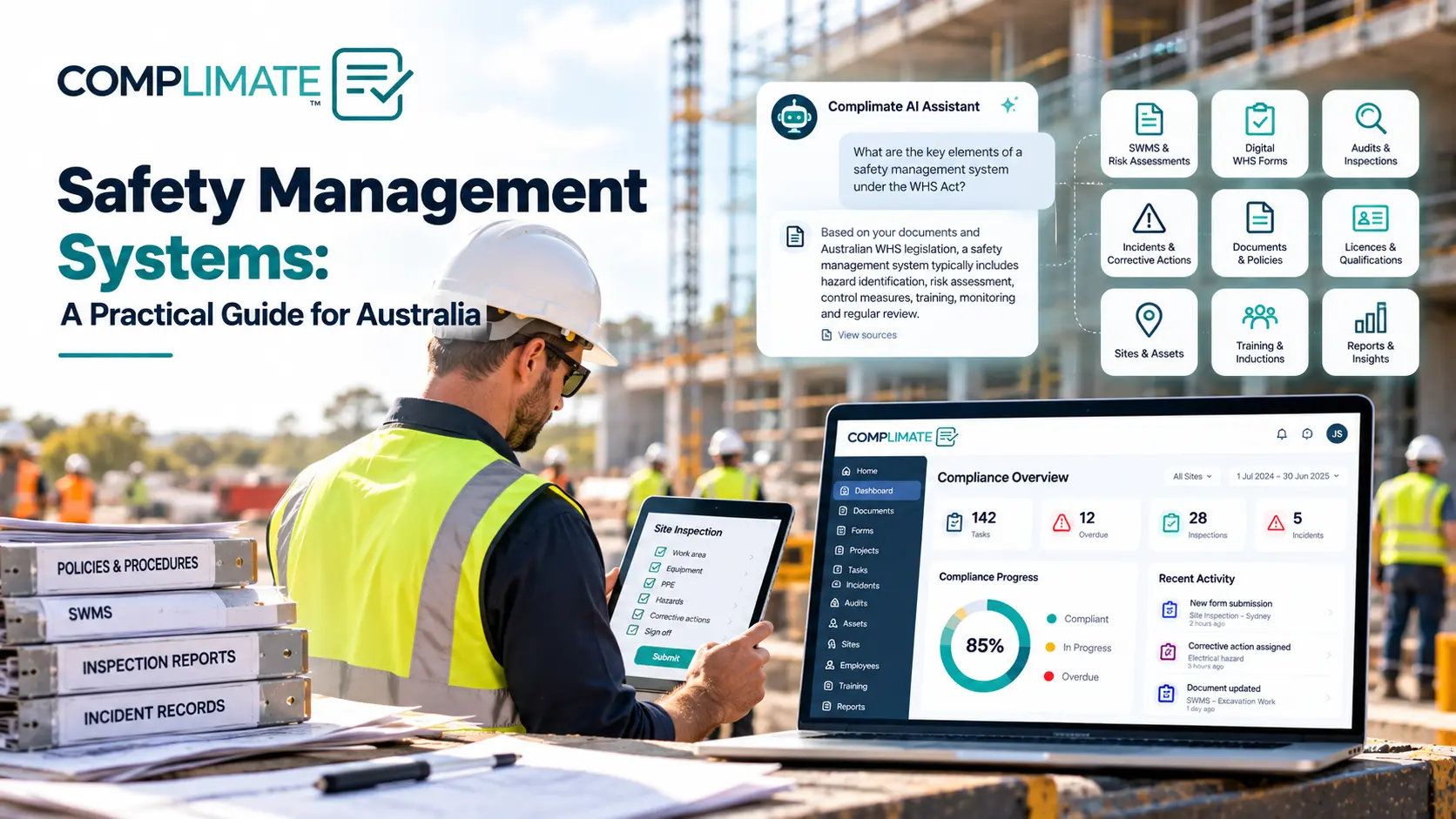
Many Australian businesses have safety policies, forms and training records. Fewer have a system that connects them.
What is a safety management system?
A safety management system is a set of policies, processes and records that a business uses to find hazards, control risks and keep improving. It covers who does what, how risks are managed, and how you check it works.
The international standard for these systems is ISO 45001:2018, adopted in Australia as AS/NZS ISO 45001. It replaced the older AS/NZS 4801, which many businesses still mention in tenders.
At a Glance
What it is: A safety management system (SMS) is a documented way to manage work health and safety (WHS) risks.
Why it matters: It turns your legal duties into daily routines.
Who should use it: Any business with workers, especially in higher-risk industries.
Biggest benefit: Consistent safety, with evidence to prove it.
Is a safety management system mandatory in Australia?
For most businesses, no. WHS laws require you to manage risks so far as is reasonably practicable, but they don't require a formal SMS or certification. Some sectors, like major hazard facilities and mines, have specific SMS rules.
In practice, an SMS is the most reliable way to show you are meeting your duties. Many clients and tenders also ask for one.
What are the key elements of a safety management system?
Most systems follow the Plan-Do-Check-Act cycle used in ISO 45001.
How do you set up a safety management system?
Build it in this order, starting from your real risks:
Write a short safety policy. Signed by senior leaders.
Assign responsibilities. Name who owns each part.
Identify hazards and assess risks. Walk the site with workers.
Apply controls. Use the hierarchy of controls: eliminate first, then substitute, isolate or engineer, then admin controls, and PPE last.
Train and consult. Make sure workers understand procedures and can raise concerns.
Monitor and review. Run inspections, track incidents and close corrective actions.
Example: a landscaping business with 15 workers identifies mowing near roads as its top risk. It writes one traffic management procedure, trains crews, and adds a weekly vehicle check. A monthly review shows two near misses, so it updates the procedure.
What are the benefits and limitations?
The main benefit is consistency. Everyone follows the same process, and you have records to show regulators, clients and insurers.
There are limits. A system on paper does not make a site safe. If workers don't use it, or nobody reviews it, it gives false confidence.
What are common SMS mistakes?
Buying a generic template. It rarely matches your actual risks.
Too much paperwork. Long procedures go unread.
No follow-through. Audit findings sit open for months.
Leaving workers out. Consultation is a legal duty, not an extra.
Key Takeaways
A safety management system connects your WHS policies, processes and records.
ISO 45001 is the recognised standard; certification is usually voluntary.
Plan-Do-Check-Act keeps the system improving.
A system only works if people use it and leaders review it.
Frequently Asked Questions
What are the main parts of a safety management system?
Policy, planning, risk controls, training, consultation, monitoring and review.
Is ISO 45001 certification required in Australia?
No. It is voluntary, but some clients and tenders ask for it.
Has ISO 45001 replaced AS/NZS 4801?
Yes. AS/NZS ISO 45001 superseded AS/NZS 4801.
Can a small business have a safety management system?
Yes. A small business can keep a simple system that matches its size and risks.
Conclusion
A good safety management system is simple, specific to your risks, and used every day. It helps you meet your WHS duties and prove it when asked.
This is general information. For complex sites, ask a qualified WHS professional.